Adopt Compliance as Code in your AWS environment — Part I — The right tools for the right job
Adopt Compliance as Code in your AWS environment — Part I — The right tools for the right job

Compliance in a Cloud world
In order to protect its business, every company in the world should define a compliance program. A compliance program is a set of requirements that meet a specific standard (internal or external). A requirement is expressed by a statement or assertion — the policy — that specifies the correct or expected behaviour of an entity. To meet the compliance program, the organization implem ents controls, defines procedures and writes guidelines that satisfy these policies. Security and governance processes must evolve to support modern Cloud infrastructures keeping in mind two things: the organization share responsibility with cloud service providers [1] and the organization must improve its business agility without compromising safety [2].
Compliance as Code (Policy as Code)
To find the right balance between agility and compliance, the security and governance team must define new rules, engage the right people, and leverage cloud technologies. One of these rules is to define your compliance policies such that they can be treated as software. The companies must adopt a new approach to planning, developing, and testing policies. Just like we use Infrastructure as Code in infrastructure automation and the approach of CI/CD in application lifecycle management, at the same time our DevSecOps teams should adopt policy-as-code, especially in a cloud world. Because the compliance program is a set of policies that meet a standard, it is more correct to speak of Policy as Code as one implementation of Compliance as Code.
Shift-Left and Shift-Righ approach
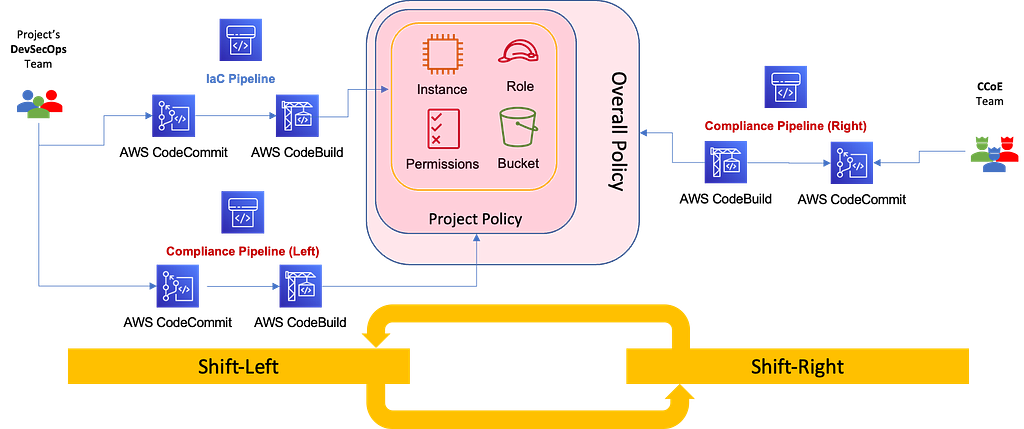
The security and compliance team should adopt the policy-as-code practice to meet compliance requirements without compromising agility. In a DevOps process, during the software development, the team can execute the tests on the left side and/or on the right side of the lifecycle. On the left side the teams test software with the goal to meet the design criteria, instead on the right side they test integration with the rest of the world [3]. We can make the same analogy for the policy-as-code practice. Working on the left side we can detect compliance issues very early in the process, but our tests are limited in scope and more related to a specific workload. On the right side, we can asses s the resources against compliance requirements defined at the organization level. On the left side, the tests are planned and executed by the project's team while on the right side the tests are planned and executed by a CCoE (Cloud Center of Excellence) team [1].

The right tools for the right job
There are different tools to implement policy-as-code in a Cloud world, most of them are open source and many others are provided directly by the cloud provider. On the left side, the tests are implemented with the goal to verify the compliance of a specific workload against a standard. Usually, on this side, there is no dependency on cloud providers so we can use general-purpose tools. On the right side, instead, we need to assess the resources against the compliance requirements defi ned at the organization level. On this side, the policies are cross-projects, cross-business and implemented by a CCoE team. On this side, the tools provided by the Cloud providers are usually more effective and straightforward to adopt.
The right tools for the right job on AWS
AWS provide different services that give you a comprehensive view of your compliance status and permit you to continuously monitor the cloud resources. In particular, to help the policy-as-code adoption, AWS provide services and features that you can put on the DevOps lifecycle both for a shift-left than shift-right approach.
Shift-Left — AWS CDK and OPA
On the left side, we can use AWS Cloud Development Kit together with a framework that simplifies policy development and management such as OPA — Open Policy Agent — an open-source engin e incubated in the CNCF. By integrating AWS CDK and OPA we can realize policy as code capability that tests the changes before AWS CDK makes changes in your AWS environment. In this scenario, CDK generates a Cloudformation template that will be validated against OPA policy document before executing a create or launch stack. In this scenario, the OPA policies are specific to the workload we are creating or updating.
Shift-Left — AWS CloudFormation Guard
On the left side, we can use AWS CloudFormation Guard an open source tool that helps validate your workload against a rule set to keep resources in compliance with the project's guidelines. Guard is an open-source command line interface (CLI) that provides a domain-specific language (DSL) to express policy-as-code and then validate JSON/YAML template against that code. Cloudformation Guard support also Terraform JSON configuratio n files and Kubernetes configurations.
Shift-Right — AWS Config Rule and RDK
On the right side, the policies are defined by a CCoE and have an overall (entire organization) scope. AWS Config and in particular the AWS Config Rules can evaluate the configuration settings for specific AWS resources or for an entire AWS account. If a resource does not pass a rule check, AWS Config flags the resource as non-compliant and notifies it. AWS Config provide also a Rule Development Kit (RDK) that simplifies your custom rule creation and management.
The importance of CI/CD
To improve the agility of compliance we must introduce a continuous compliance workflow in which our DevSecOps team and/or our CCoE team can release policies in continuous integration and continuous deployment (CI/CD) fashion. Following the decoupling best practice we will put alongside the pipeline of Infrastructure and application the pipeline for compliance. To implement CI/CD pipeline we can use AWS Developer Tools such as Codepipeline, Codebuild and Codedeploy.
Reference
[1] AWS Shared Responsibility Model
[2] Governance in the AWS Cloud: The Right Balance Between Agility and Safety
[3] Shift left vs shift-right: A DevOps mystery sol ved
Adopt Compliance as Code in your AWS environment — Part I — The right tools for the right job was originally published in Towards AWS on Medium, where people are continuing the conversation by highlighting and responding to this story.
Comments
Post a Comment